Bandung’s Cultural Afterlives – edited by Hala Halim and Ziad Dallas
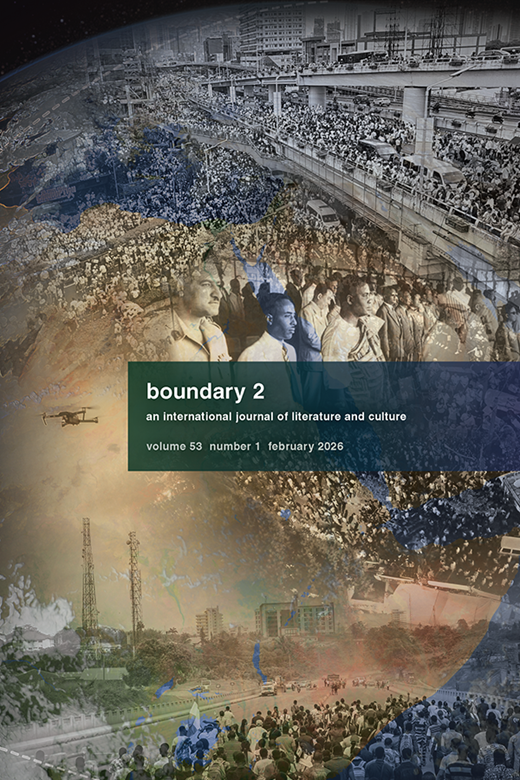
Description
(From the Introduction, by Hala Halim and Ziad Dallas) “Our present issue of boundary 2, then, harks back to the Bandung Conference to go on to trace its afterlives—not its legacy but rather its abiding relevance—along different trajectories and in a variety of forums and diverse idioms attesting to its animating spirit.
Albeit not without predecessor conferences—if on different scales and with only partially overlapping agendas—Bandung, which convened state representatives of twenty-nine recently decolonized nations, has come to powerfully signify the official emergence of the Third World as a force on the international scene. A turning point for the nascent Third World, Bandung served as a springboard for several movements, institutions, and projects. Recapturing something of the contemporaneous import of the conference at this distance in time is a task that an expanding body of scholarship has been grappling with recently. That inquiry is perhaps less demanding than tracking Bandung’s cultural afterlives—though these likewise have become a subject of scholarship in the past decade or so—on account of their extensiveness and their wide-ranging cross-continental diffusion.
This special issue of boundary 2 brings together scholars of literature, history, and the visual arts to reflect on the radiating presence of Bandung in the cultural and intellectual life-worlds of the Global South in the second half of the twentieth century. As befits Bandung’s afterlives, our contributors draw on an array of sources, among them, plays, poems, biographies, criticism, periodicals, newspapers, reportage, archival documents, and oral history in Arabic, French, Urdu, and Russian. Their contributions in different genres—interdisciplinary and comparative scholarship, personal testimony, reflection, and visual essays—chart points in the geography of the liberation period, to trace internationalist trajectories in, as well as between, Algeria, Egypt, Ethiopia, Indonesia, Iraq, Lebanon, Pakistan, Turkey, and Vietnam, among others.”